How to scale advertising without losing profitability
The advertising is working: a $500/month budget, 600% ROAS, leads coming in steadily. You double the budget — and within two weeks ROAS falls to 250%. A month later the campaign is barely breaking even. What happened?
This is not a coincidence or a technical glitch. It is a pattern we encounter in every second account we take over after «self-managed scaling». The algorithm is not failing you — it is behaving exactly as it should, given the commands it was handed.
In this article we break down how scaling actually works: why ROAS falls when you raise the budget abruptly, which rule really preserves profitability, and what signals the algorithm sends when it is time to change tactics.
Why the algorithm dislikes abrupt changes
Meta’s and Google Ads’ algorithms are permanently in learning mode. They analyse who clicks, who buys, at what time, on which device, after which actions — and build a model of the «ideal buyer» for your specific offer.
A sharp budget increase breaks that model. Not because the algorithm «panicked», but because a larger budget requires the system to find more people to show your ads to. If the budget doubles in a day, the algorithm starts moving beyond the well-studied audience and looking for «similar» but less proven people. The market saturates faster, auction competition rises, CPM climbs — and cost per conversion with it.
The second effect is resetting the learning phase. In Meta Ads, «learning» stays active until the campaign has accumulated 50 conversions per week. A sharp budget change returns the system to «still learning» and it starts working out who to spend money on all over again. This is exactly when efficiency sags, and most owners make the same mistake: they panic, switch off ad sets, cut the budget back — and instead of stabilising they get a second round of degradation.
VELAR’s conclusion: scaling is not «dragging the slider». It is a managed process of gradually expanding reach while simultaneously monitoring efficiency metrics.
The 20–30% rule: why that figure
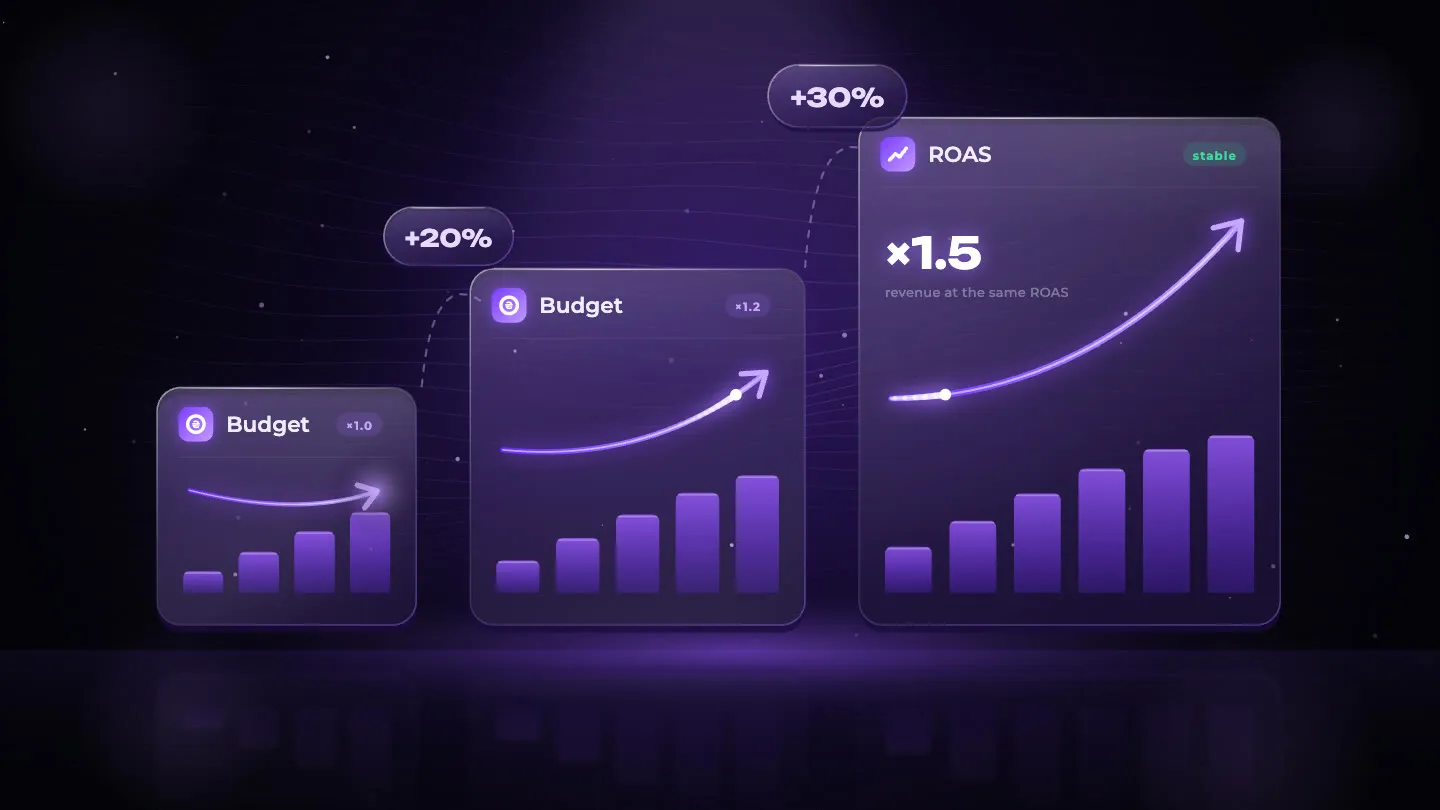
Practice shows that the safe threshold for a budget increase is no more than 20–30% of the current level per step, and no more often than once every 2–3 days.
At that pace the algorithm has time to adapt to the new volume of traffic without leaving the learning phase. In practice it is the only way to raise a budget «invisibly» as far as the system is concerned — it reads the change as organic growth in demand rather than a restart.
This is exactly how we scaled campaigns in the TOP TREND case — a product business in Poland (homeware and garden goods, appliances, tools). Once campaigns had reached the target cost per lead, we increased the budget by 20–30% every 2–3 days, for as long as the metric held inside KPI. Underperforming campaigns were not switched off immediately: first we lowered the budget or relaunched them — and often they came back into play. The result: 3,979 leads and 1,478 sales from the site on a realised budget of ₴1m.
When cost per lead starts rising, the right response is not to cut the budget to zero but to hold at the current level for 3–5 days, let the algorithm stabilise, and only then move on.
Vertical vs horizontal scaling
When most owners say «increase the budget», they mean vertical scaling — simply raising the amount on an existing campaign. But that is only one of two tools, and at large scale it eventually hits a ceiling.
Horizontal scaling means expanding reach along new axes: new audiences, new geographies, new formats, new products or languages. Each axis gives the campaign access to a «fresh» pool of people without competing against itself for the same audience.
| Vertical | Horizontal | |
|---|---|---|
| What changes | budget on the existing campaign | new audiences / geos / products / formats |
| When to use it | campaign is profitable, audience not exhausted | current audience is saturating, or you want new markets |
| Risks | audience fatigue at excessive budget | budget spread thin across campaigns, harder analytics |
| Effect on the algorithm | may reset learning on a sharp jump | each new campaign goes through its own learning phase |
| Growth potential | limited by audience size | unlimited (new markets, niches, products) |
In real work we combine both approaches. While vertical scaling gradually raises the budget on proven campaigns, horizontal scaling tests new pockets in parallel: Look-alike 2–5% audiences, new countries, a new video format. When a horizontal campaign reaches KPI, we scale that vertically too.
Signs of audience fatigue: three signals
Audience fatigue is the state in which your advertising has already been shown to everyone «suitable» in the chosen segment, and the system starts showing the same ads to the same people over and over. Efficiency falls — not because the advertising is bad, but because the audience «has seen this».
Three indicators that signal fatigue:
1. Frequency above 3–4. This means the average member of your audience has seen your ad more than three times. For a cold audience that is rarely justified — if a person has not responded after two or three impressions, the fourth and fifth will only irritate them.
2. CTR drops by 20–30% or more. The same offer to the same audience — but fewer clicks. The most common cause is not the quality of the ad copy but the fact that the audience is tired of this creative.
3. CPM and cost per conversion rise with no change in bids. The auction becomes more expensive because the algorithm has already «exhausted» the cheapest pool and is now paying more for less relevant people.
If you see two out of three, there is fatigue. There are two options: refresh the creatives (if the audience is still large) or widen the audience (add new segments or switch to a broader Look-alike percentage).
Creatives: when and how to refresh them
Scaling without refreshing creatives is an invitation to fatigue. With a larger budget the campaign «works through» the audience faster, and ads wear out sooner.
When to refresh? As a guideline, every 4–6 weeks, or when CTR falls by more than 25%. But do not replace everything at once: refresh one or two variants and keep the winners. That way the algorithm is not reset to «learning from scratch» but simply tests new combinations.
What to refresh first? The first second of the video or the first frame of the image. That is what decides whether a person stops scrolling. Copy and headline are the second priority.
Formats. In the TOP TREND case, video creatives with voiceover and subtitles performed considerably better than static — they delivered a cheaper lead. This confirms the general trend: when scaling, video more often holds cost per conversion longer than static, because a clip carries higher informational density.
VELAR’s approach: we do not «replace» advertising when scaling — we grow the creative library. Six to eight active variants give the algorithm more combinations to rotate and extend the shelf life of each one.
Look-alike: expanding without losing quality
Look-alike audiences (LAL) are one of the most effective tools for horizontal scaling. You take a base of «quality» buyers or leads and ask the algorithm to find similar people among millions.
LAL 1% — the narrowest and most precise: the people most similar to your base. More expensive in the auction, but converts better.
LAL 2–5% — a broader audience, less precise but larger in volume. When LAL 1% is exhausted, 2–5% provides the next pool.
At TOP TREND, Look-alike 1–5% built on people who had already completed the target action delivered the most accurate result among all the audiences we tested. Retargeting was tested too — but it did not meet expectations for this business and was dropped. The conclusion: audience structure has to be tested, not copied.
Important: the quality of a LAL depends directly on the quality of the base. Fifty buyers and the algorithm builds a model on limited data. Five hundred to a thousand or more buyers and the LAL becomes far more accurate. This is precisely why Look-alike «does not work» for projects at the start: there is no sufficient base.
Checklist: are you ready to scale?
We do not take on scaling until we have confirmed readiness on every point.
Before raising the budget:
- The campaign has exited the learning phase. In Meta Ads, at least 50 conversions per week on the target event. While it says «learning» or «learning limited», scaling is premature.
- ROAS or CPL has held steady for 7–14 days. Not one record day, but a settled trend without large swings.
- Tracking is confirmed. Conversions are recorded correctly, there are no duplicate events, and the target event is a real purchase or lead rather than a page view.
- There is audience headroom. Frequency < 2.5, reach not yet exhausted. If frequency is already 4, even a correct budget step will achieve nothing.
- New creatives are ready. Scaling puts extra load on the audience. Without a refreshed pool of ads, fatigue arrives faster.
Raise the budget in steps of 20–30% and wait 2–3 days. If the metrics hold, take the next step. If CPL rises or ROAS falls, stop, stabilise, and only then move on.
VELAR’s position: scaling is not a button you press
There is a mistaken belief that once a campaign «takes off» you simply raise the budget and watch sales grow. That is not the case, and we are reminded of it on every project.
Scaling is a separate body of work. It requires regular monitoring of frequency and CTR, timely creative refreshes, parallel horizontal tests, the right pace of budget increases and a response when metrics deviate. One wrong step costs more than reduced ROAS — it can throw the campaign back into learning and take two or three weeks with it.
That is why we treat scaling as a separate process, with a clear protocol, checkpoints and the understanding that steady 20% monthly growth beats a sharp climb followed by an equally sharp collapse.
If your advertising is already profitable and you want to understand how far you can safely scale without losing that profitability, this is exactly what we examine in a free audit. We look at your current campaign structure, audiences, frequency and tracking — and show you the specific next step.
Read also:
- «7 mistakes in a DIY ad launch that drain your budget»
- «What ROAS is and what counts as a good figure»
- «Meta Ads or Google Ads: which to choose for your business»
Frequently asked questions
Why does ROAS fall when you increase the budget?
When the budget jumps sharply (by more than 30% at once), the algorithm exits the learning phase and starts looking for a new audience — broader, but less warmed up. At the same time auction competition rises, CPM goes up and so does cost per conversion. This is not a bug, it is how the algorithm works. The fix: gradual steps of 20–30% every 2–3 days, combined with horizontal scaling into new audiences.
By what percentage should I raise the budget at a time?
The safe threshold is no more than 20–30% of the current budget per step. That lets the algorithm readjust without a full reset of the learning phase. If cost per lead or cost per conversion starts rising, hold at the current level for 3–5 days, stabilise, and only then move on.
What are vertical and horizontal scaling?
Vertical means increasing the budget on existing campaigns without changing the structure. Horizontal means launching new ad sets or campaigns targeting new audiences, geographies, languages, products or formats. The most durable growth comes from combining both: vertical increases volume on proven campaigns, horizontal finds new pockets of efficiency.
How do I know the audience has burned out?
Three signals: (1) frequency exceeds 3–4 for a cold audience; (2) CTR drops by more than 20–30% versus the previous week; (3) CPM and cost per conversion rise even though bids and budget have not changed. If you see two out of three, it is time to refresh creatives or widen the audience.