Meta Ads or Google Ads: which to choose for your business
«Meta or Google?» is one of the most common questions at a first client meeting. And it is almost always asked as an either/or choice, when in reality it is a question of strategy, not platform. The answer depends on how your customer searches for and buys your product.
Let’s break it down without dodging: what the fundamental difference between the two channels is, which niches and goals each works better for — and when it genuinely makes sense to run both.
The key difference: push vs pull
This is the most important thing to understand before making any choice.
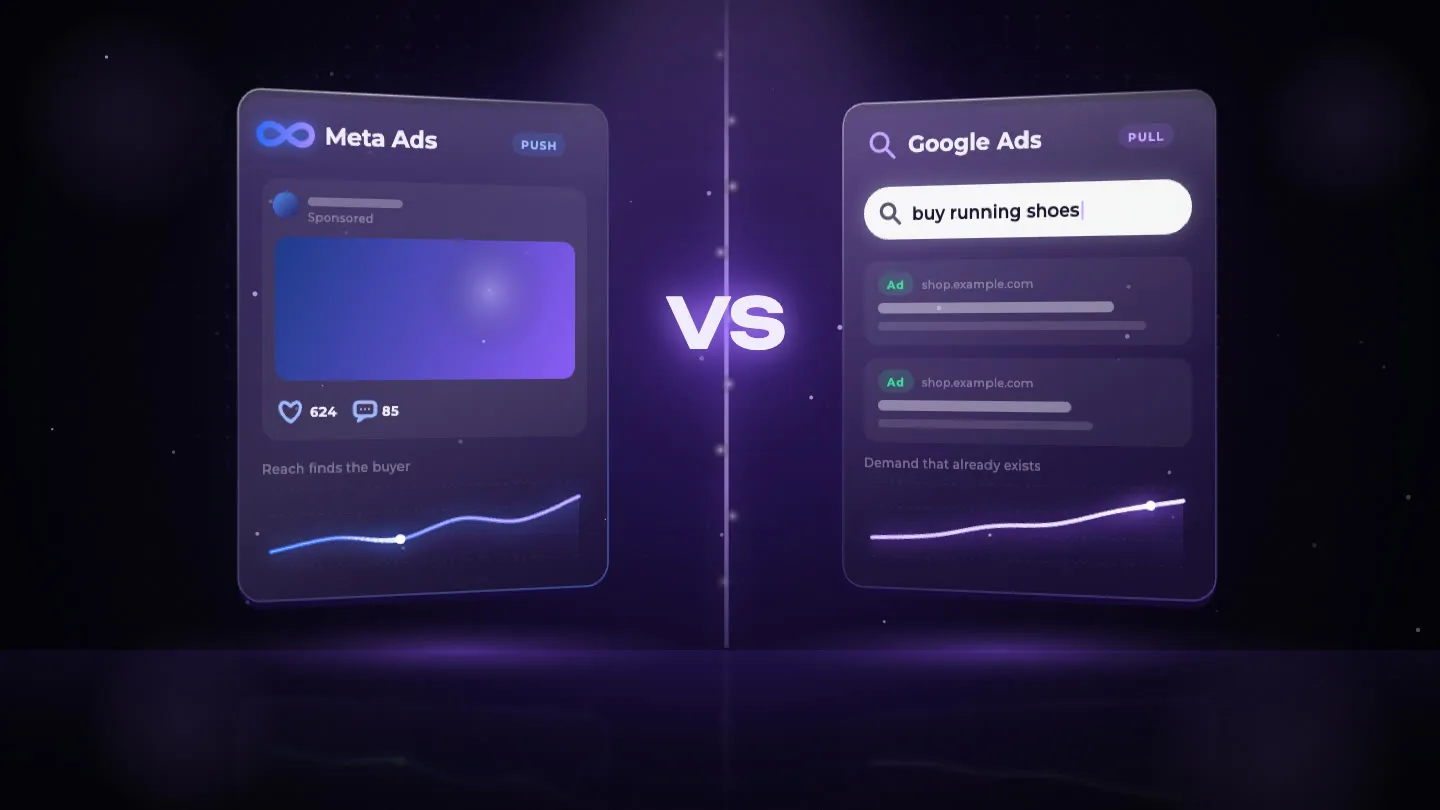
Google Ads is advertising against existing demand (pull). The person already wants to buy something, is already searching for «buy Nike trainers size 42» — your ad simply appears in response to that intent. You catch ready buyers at the moment of decision.
Meta Ads is demand generation (push). The person was not looking for your product, but while scrolling the Instagram or Facebook feed they run into your offer and think: «Oh, I need that». You create a desire that did not exist a few seconds earlier.
Everything else follows from this difference: which funnels to build, how to evaluate the result, and how much time the algorithm needs to «learn».
When Meta Ads is the right choice
Meta (Instagram + Facebook) wins where visual presentation plays the decisive role and where the purchase happens through emotion or inspiration.
- Clothing, accessories, cosmetics, homeware — people buy «with their eyes». When the product looks good in a photo or video, conversion comes naturally.
- New or niche products with no search demand. If people do not know your product exists, they will not search for it on Google.
- Local businesses and services with a broad audience — restaurants, beauty services, fitness. Meta’s geo-targeting lets you reach people who live or spend time nearby.
- Retargeting — reminding people who already visited the site, added to cart or watched a video. Meta Advantage+ Catalog performs very effectively here.
- Look-alike audiences — if you have a customer base, Meta builds similar audiences better than any manual targeting.
The average ROAS of our clients on Meta is 598% (meaning every hryvnia invested in advertising comes back ×5.98). But this is not an automatic result — it follows from the right creative, the right funnel and optimisation for conversions rather than clicks.
When Google Ads is the right choice
Google wins where there is explicit search intent and where the stakes are high.
- Services with direct demand — dentistry, appliance repair, legal services, freight. The person is looking for a specific solution to a problem right now.
- Expensive products with a long consideration phase — furniture, appliances, cars, renovations. The buyer compares options in search — you need to be there.
- B2B and wholesale — purchasing decisions are often made through a search query, not through Instagram.
- Google Shopping for e-commerce — if someone is looking for a specific model or category, a Shopping ad with a photo, a price and the store name closes the deal faster than any banner.
- Performance Max — Google’s automated campaign type covering every placement: Search, YouTube, Gmail, Display. We cover it in detail in a separate article.
For niches involving transport and logistics, as in the TOPTRANF case, Google Ads delivered a steady flow of B2B leads precisely because people make freight decisions through search rather than through a feed.
A comparison across the key parameters
| Parameter | Meta Ads | Google Ads |
|---|---|---|
| Type of demand | generates it (push) | captures existing demand (pull) |
| Best format | video, carousels, Stories | search ads, Shopping, PMax |
| Decision cycle | shorter (impulse) | longer (comparison) |
| Visual component | critically important | less critical |
| Retargeting | very strong | present, but weaker |
| Look-alike audiences | excellent | more limited |
| B2B and expensive services | harder | natural habitat |
| Cost of training the algorithm | 50+ conversions | depends on campaign type |
What if you launch both channels at once
Running Meta and Google simultaneously is the right move, but only if your budget and analytics allow you to do it without spreading yourself thin.
The synergy looks like this:
- Google captures those already searching — high conversion, but a limited audience pool.
- Meta builds brand awareness and creates demand — more people enter the funnel.
- Meta retargeting «finishes off» those who arrived from Google but did not buy.
The result is full coverage of the customer journey: from first contact to purchase. This is exactly the principle we used to build the advertising funnel in the Play Vinyl case: Meta created demand and traffic to the site, and Google Ads closed those who came back with intent to buy.
But there is a condition: for the system to work, each channel has to be set up for its own role and evaluated separately. If you blend the budgets into one «general advertising» pot without clear attribution, you will never understand what is actually bringing in sales.
How we choose the channel for clients at VELAR
Before any launch we run an audit answering three questions:
1. Is there search demand? If people are already searching for your product on Google, ignoring that is expensive. We check through Keyword Planner and by analysing competitors in search.
2. What does your product look like? If visual presentation is a strength (clothing, food, decor, services), Meta will deliver more for the same budget.
3. What is the average order value and the deal cycle? Expensive decisions made over weeks are often driven through search. Impulse purchases come through the feed.
On that basis we put together the first proposal: which channel we start with, which budget goes where, and what ROAS is realistically achievable in your niche. No generalities — specific forecasts.
If you want to see which channel suits you, we start with a free consultation. And if you have not yet decided whether to delegate advertising at all, read «Targeting yourself or an agency»: numbers, no embellishment.
Frequently asked questions
What is better for an online store — Meta Ads or Google Ads?
It depends on whether there is search demand for your product. If people are already searching for your product on Google, search advertising delivers hot traffic. If the niche is new, or the product sells on impulse and inspiration, Meta Ads is more effective at generating demand. Usually the best result comes from combining both channels.
Can I start with Google and Meta at the same time?
Technically, yes. But at the start it is better to focus on one channel, get the funnel working and understand your unit economics. Splitting the budget across two platforms before the first one is profitable more often ends with neither reaching the black.
How much do I need to spend to know whether the advertising works?
The budget has to cover 50+ conversions so the algorithm can exit the learning phase. The exact amount depends on your cost per lead and your niche. At the start, the daily budget matters more than the total — an algorithm cannot learn on $3 a day.
Google Shopping vs a Meta catalogue — which is more effective for e-commerce?
Google Shopping works excellently for categories with direct search demand (furniture, electronics, clothing from known brands). Meta Advantage+ Catalog performs well when you need to «remind» people who have already visited your site, or to find a new audience from behavioural signals. Together they cover the whole customer journey.