How much Google Ads costs: what makes up the budget

«How much does Google Ads cost?» is a question that comes up in every first client meeting. And the honest answer here is even less obvious than for Meta Ads: in Google Ads you are not buying impressions, you are entering an auction for a specific intent to buy, and the price of that intent can differ by a factor of 50 between niches.
This article avoids abstract «market averages»: we break down what makes up the budget, how the cost of a click is formed, how much you really need at the start, and how a Search budget differs from a Performance Max budget. And we show, using figures from two of our Google Ads cases, what this looks like in practice.
What makes up a Google Ads budget
As with any advertising, there are two fundamentally different categories of spend here — and they are the ones most often confused.
| Component | Where it goes | What it depends on |
|---|---|---|
| Ad budget | directly into Google’s auction | niche, competition for the query, number of keywords, seasonality |
| Specialist/agency work | to a freelancer or an agency | scope of work: setup, management, feed optimisation |
| Product feed and creatives | Merchant Center preparation, banners, video | mostly one-off, then maintenance |
| Analytics and tracking | conversion pixel, GA4, CRM integration | one-off setup plus periodic audit |
The main difference from targeted advertising is that the ad budget in Google Ads is not a fixed sum for «impressions» but a bid in an auction, redistributed daily depending on how many competitors are claiming the same audience at the same moment. So any figure of «X per month» with no reference to niche and queries is an estimate, not a calculation.
How the auction forms the cost per click (CPC)
This is the key difference between Google Ads and social media, and it is where the answer to «why is it so expensive in my niche» hides.
When a user enters a query, Google instantly runs an auction between every advertiser competing for that phrase. The winner is not simply whoever bids most — the winner is determined by Ad Rank, which takes into account:
- The bid — the maximum you are prepared to pay for a click;
- Quality Score — how relevant your ad and landing page are to the query itself, and your historical CTR;
- The expected impact of extensions and ad format — sitelinks, prices and a phone number raise the ad’s expected effectiveness.
This has a practical consequence: two advertisers with the same bid pay different prices per click. The one with higher ad and page relevance pays less for the same search query and the same position. So the cheapest way to reduce CPC is not to «cut the bid» but to raise relevance: a sharper headline matched to the query, a faster page, closer correspondence between the ad and what the person actually searched for.
This is exactly why «how much does a click in Google Ads cost» has no single answer. In a niche with low competition and a narrow long tail of queries, a click can cost a few hryvnias. In legal, medical or financial services with a high average order value, companies deliberately pay tens or hundreds of hryvnias per click, because one client repays it many times over.
There is also a hidden saving lever that is rarely considered at the start — negative keywords. The auction runs on every query the system deems relevant to your keywords, including ones you never intended. A store selling new trainers, with no negative keywords, will get impressions and clicks on «used trainers» or «trainer repair» — people click, you pay for them, and there will never be a conversion, because the intent is different. Regularly cleaning search terms and expanding the negative keyword list is not «minor optimisation» but one of the fastest ways to lower average cost per conversion without raising the budget. In our practice, this kind of work filtering out irrelevant traffic often produces a greater effect in the first month than raising bids does.
What you need at the start: the minimum budget for the algorithm to learn
The second most common question is «what is the minimum to set aside». The same rule applies here as in any algorithmic advertising system: the algorithm needs a volume of data to work out who it is profitable to show ads to and who it is not.
If the budget only allows a few clicks a day and single-figure conversions per week, the campaign technically «works» but statistically never learns anything. Every decision the algorithm makes rests on too small a sample, and the result looks random: cheap leads one day, none at all for several days after.
The practical benchmark is that the budget should cover a steady flow of clicks and at least a few dozen conversions per week, depending on the campaign type. A search campaign with a narrow, high-converting set of keywords can reach stability faster and on a smaller budget than Performance Max, which needs a broader flow of data across all of Google’s inventory from the outset.
What this means in practice:
- Do not spread a minimal budget across dozens of keywords at once — it is better to focus on a narrow but relevant core of queries.
- Calculate the budget from the cost per click in your niche, not from an arbitrary sum — $300 in a niche with a ₴3 CPC and $300 in a niche with a ₴90 CPC produce entirely different volumes of learning data.
- Budget separately for the learning phase — the first 1–2 weeks are almost always more expensive than the settled result, and that is a normal payment for data rather than a campaign failure.
We calculate the exact minimum budget for your niche and cost per click during a free Google Ads audit — which also immediately shows whether there is enough market demand to make the advertising pay at all.
Budget by campaign type: Search, Shopping, Performance Max, Display
Another reason «how much does Google Ads cost» is a complicated question: inside Google Ads itself, different campaign types have entirely different economics.
| Campaign type | Where it appears | Typical cost per click | What you need to start |
|---|---|---|---|
| Search | Google search results | the highest of the formats, because this is direct intent to buy | a narrow core of keywords, negative keywords |
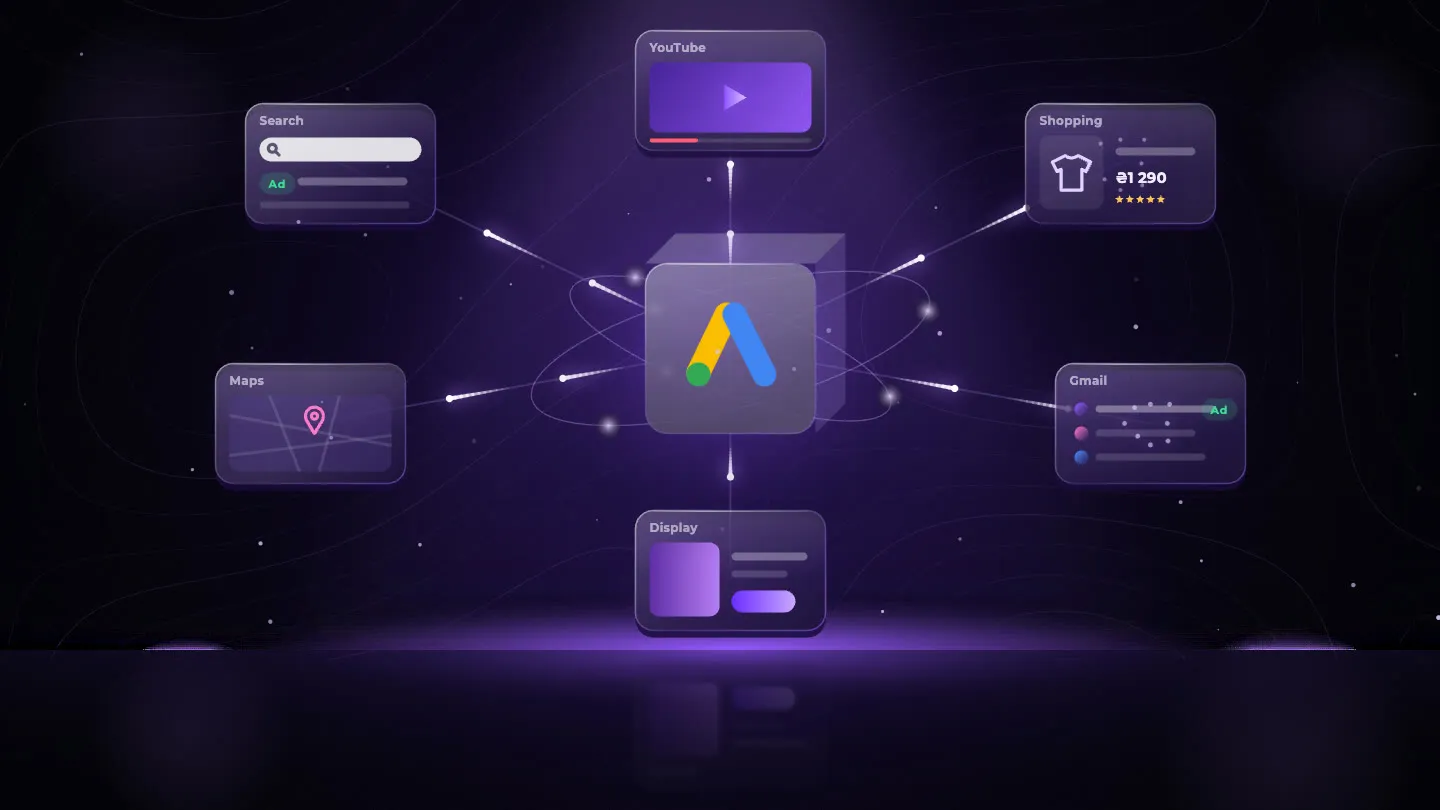
| Shopping / Performance Max | Search + Shopping + YouTube + Display + Gmail + Discover | lower per click than pure Search, thanks to cheaper inventory | a product feed in Merchant Center, a steady flow of conversions |
| Display Network | banners on partner sites | the lowest cost per click of all | large impression volume for awareness, not for immediate sales |
| YouTube / DemandGen | video and Google service feeds | medium, depends on format | a quality video creative or asset set |
An approximate ratio based on our practice; exact figures always depend on the niche and geography.
The main practical conclusion from this table: a search campaign captures existing demand and almost always costs more per click, but that click is «hotter». Performance Max and Shopping bring Google’s cheaper channels in alongside search and often deliver a lower overall cost per conversion — but only if there is a quality product feed and enough data to learn from. We examined the mechanics of Performance Max, and why it does not work in every niche, in a separate article: «Performance Max in Google Ads: how it works and who it suits».
Real budgets and results from VELAR’s practice
To keep this out of the realm of theory, here are the figures from two of our Google Ads cases.
PLAY VINYL — a premium audio brand: vinyl records and speaker systems. The baseline for the 6 months before our work: CPC ₴8, CPM ₴101, a monthly budget of $3,200, 846 conversions at a cost of ₴939.4, ROAS 791%. The problem was not the size of the budget but how it was distributed: some campaigns were burning money with almost no conversions, and optimisation was running against several goals at once.
We removed the inefficient campaigns, moved to Performance Max with a focus on a single conversion, switched to a target ROAS strategy and segmented a product feed of 5,910 items. On an almost unchanged budget of $3,200/month we achieved 1,509 conversions at ₴565.84 and a ROAS of 1,091%.
The second example is TOP TREND, a product business: homeware and garden goods, car accessories, small electronics. Here the task was different — not to reduce cost per conversion on an existing budget but to hold cost per lead within a KPI of ₴150–450 and scale the volume, and to do so without access to Google Merchant Center or Google Analytics, because the client operates as an intermediary.
Through Performance Max and DemandGen, with each product split into its own campaign and landing page, we delivered a budget of over ₴1m and generated 5,000+ leads at an average cost of ₴297.86 — inside the target KPI, despite the harder starting conditions and limited analytics.
The difference between these cases shows the main point: a budget is not a universal figure but a function of niche, competition and campaign structure. The same budget in different conditions produces radically different results — and that is precisely why «how much does advertising cost» is never answered with a single number without business context.
How to tell whether your budget is working
The amount spent says nothing about effectiveness on its own. What you need to look at is the ratio of spend to result:
- ROAS (return on ad spend) — how much revenue each hryvnia invested brought back. In the PLAY VINYL case, 791% → 1,091%.
- Cost per conversion/lead relative to your margin and KPI — as at TOP TREND, where the key metric was not the budget but holding cost per lead within ₴150–450.
- The trend, not a single snapshot — cost per click and per conversion naturally fluctuate week to week; what matters is the trend over 4–6 weeks, not one good or bad day.
Another common mistake is to assess the cost of advertising in isolation from how much a client brings the business over the whole relationship rather than in a single order. If the average client returns for repeat purchases or a subscription, a conversion that looks expensive at first glance still pays for itself many times over, because the comparison should be CPA against customer lifetime value (LTV), not CPA against the value of a single order. This is especially critical in niches such as services, subscriptions and B2B, where the first deal is often not profitable at all — the profit comes from the second and third purchase. A business that abandons advertising because of an «expensive lead» without calculating LTV most often abandons a profitable channel on the basis of the wrong metric.
The average across VELAR clients is a ROAS of 598% across more than 55 niches, and together we have generated over $5.56m for clients. This does not mean any budget will automatically produce such a result — it means the right budget and campaign structure is capable of delivering that kind of return.
VELAR’s position: a budget is not an expense, it is a calculation
Our position is simple: «how much does Google Ads cost» is the wrong question. The right question is «how much does a client in my niche cost through Google Ads, and is it worth paying that much for one». And the answer always comes from the auction in your specific niche, not from a market-average figure in an article on the internet.
We do not quote a fixed «turnkey» price without an audit — and we tell clients honestly when CPC in their niche is too high for their margin, and when, conversely, the market is undervalued and it is worth moving in ahead of competitors. That approach is what gave PLAY VINYL ROAS growth with no budget increase, and TOP TREND a steady flow of leads within KPI even without access to analytics.
If you want to find out what a client from Google Ads will really cost in your niche — and whether your budget is enough for a meaningful start — request a free audit. We will show you the real cost of a click and a conversion in your category, not an approximate figure from the internet.
Read also:
- «Performance Max in Google Ads: how it works and who it suits»
- «How much targeted advertising costs in Ukraine: what makes up the budget»
Frequently asked questions
How much does Google Ads cost per month?
There is no single figure — the cost consists of the ad budget, which goes directly into Google's auction, and payment for a specialist's or agency's work. The ad budget depends on your niche, the average cost per click (CPC) and the number of conversions needed for the algorithm to learn. An exact figure for a specific business can only be given honestly after a short audit of the account and the niche.
How does cost per click in Google Ads differ from the cost in Meta?
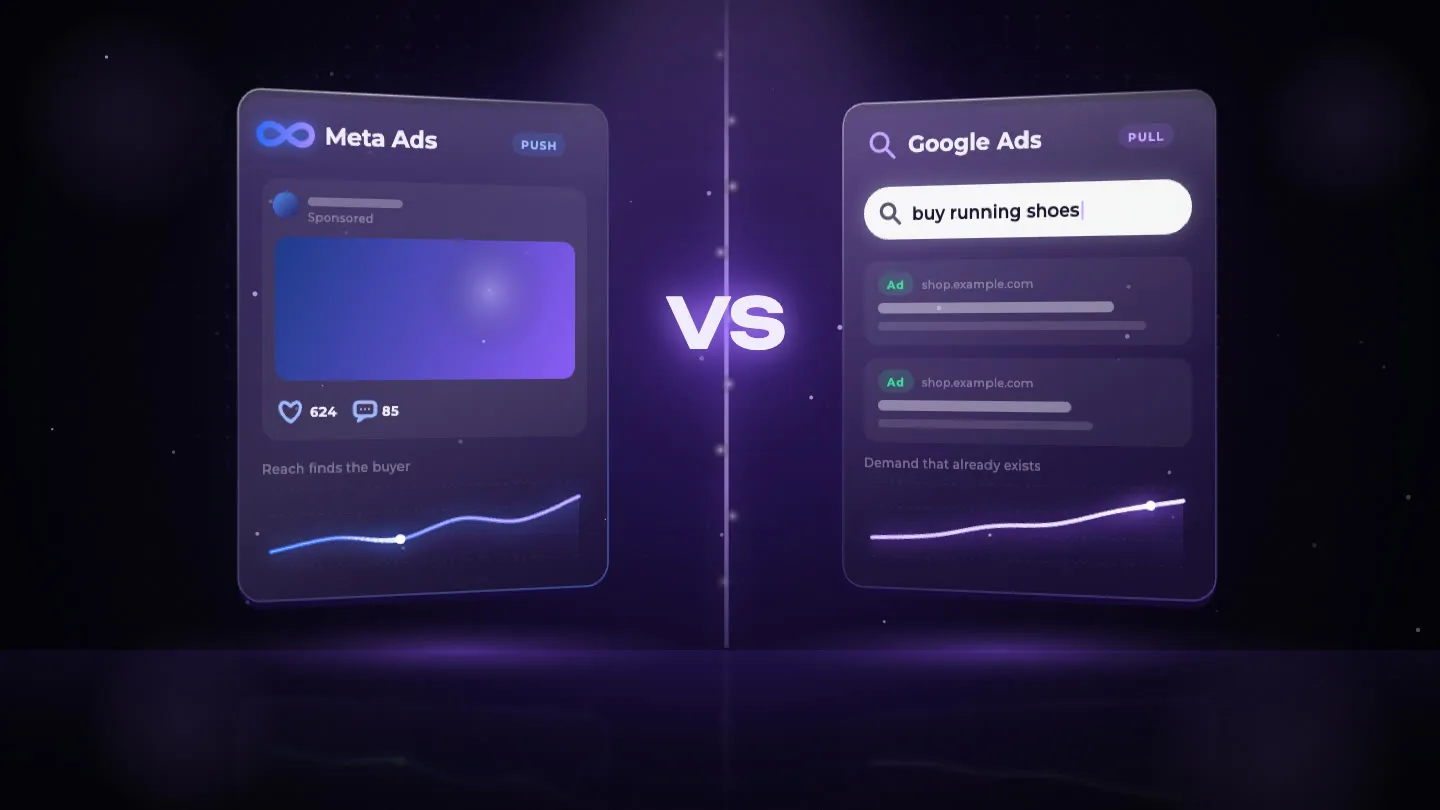
In Google Ads you pay for intent: the person is already searching for your product or service, so the cost per click is tied to competition for a specific search query and to your ad's Quality Score. In Meta you pay for attention in the feed, and the price depends more on the creative decision and the breadth of the audience. Comparing CPC in Google with CPM in Meta directly is therefore misleading — the economics of a click are different.
What is the minimum budget to start with Google Ads?
There is no universal minimum — it depends on the cost per click in your niche and on how many conversions the algorithm needs to learn. As a guideline: the budget has to cover enough clicks and conversions per week, otherwise the campaign simply never accumulates data. We show the exact calculation for your niche during a free audit.
Is Performance Max more expensive than search campaigns?
Not necessarily — PMax often delivers a lower cost per conversion where search clicks are expensive, because it brings more affordable inventory (YouTube, the Display Network, Discover) into a single campaign. But it needs a product feed and a steady volume of conversions to learn from. Which is cheaper in your specific niche — Search or PMax — depends on the cost per click and the volume of data.
Why is CPC ₴3 in one niche and ₴300 in another?
Cost per click in Google Ads is set by the auction for a specific query: how many advertisers are competing for that same phrase and what margin their product carries. In legal, medical and high-value B2B niches, companies willingly pay tens or hundreds of hryvnias per click, because one client repays it many times over. In niches with a low order value and low competition, a click costs pennies — but the value of each click is correspondingly lower.