Creatives that sell: video, static and UGC in Meta Ads
«The advertising isn’t working» — and in most cases the cause is not the audience, not the budget and not the account settings. The cause is the creative.
In Meta Ads in 2025–2026 a simple rule applies: the algorithm finds the audience, but the creative turns a person into a buyer. This is where most advertisers lose money — not on poor targeting, but on ads that fail to stop the scroll.
In this article we break down the three key formats — video, static and UGC — explain what genuinely works and when, and show how to test without burning budget on guesswork. With real cases from our practice.
Why in Meta Ads the winner is whoever bets on creative
A few years ago a media buyer’s skill was measured by their ability to configure audiences: precise interests, exclusions, narrow look-alikes. Today the rules have changed.
Meta has radically simplified targeting and shifted the heavy lifting onto the algorithm. Advantage+ Audience, broad targeting with no manual settings, automatic placements — the system finds buyers better than manual targeting did in 2019. If you still spend more time configuring audiences than on the quality of your ads, you are playing the previous generation’s game.
What this means in practice: your creative is your targeting. When you shoot a video for women aged 28–45 who do yoga and buy sports equipment online, Meta’s algorithm finds those people on its own, without a single manual interest. The ad attracts the right audience through its content, not through your settings.
The consequence: budget no longer decides the way it used to. Two businesses with the same budget, the same audience and different creatives will get radically different results. The winner is the one whose ad stops the scroll.
Three formats: video, static and UGC — and where each lives in the funnel
Before choosing a format you need to understand which stage of the funnel it will appear at and what job it has to do. There is no «best» format — there is the right format for a specific task.
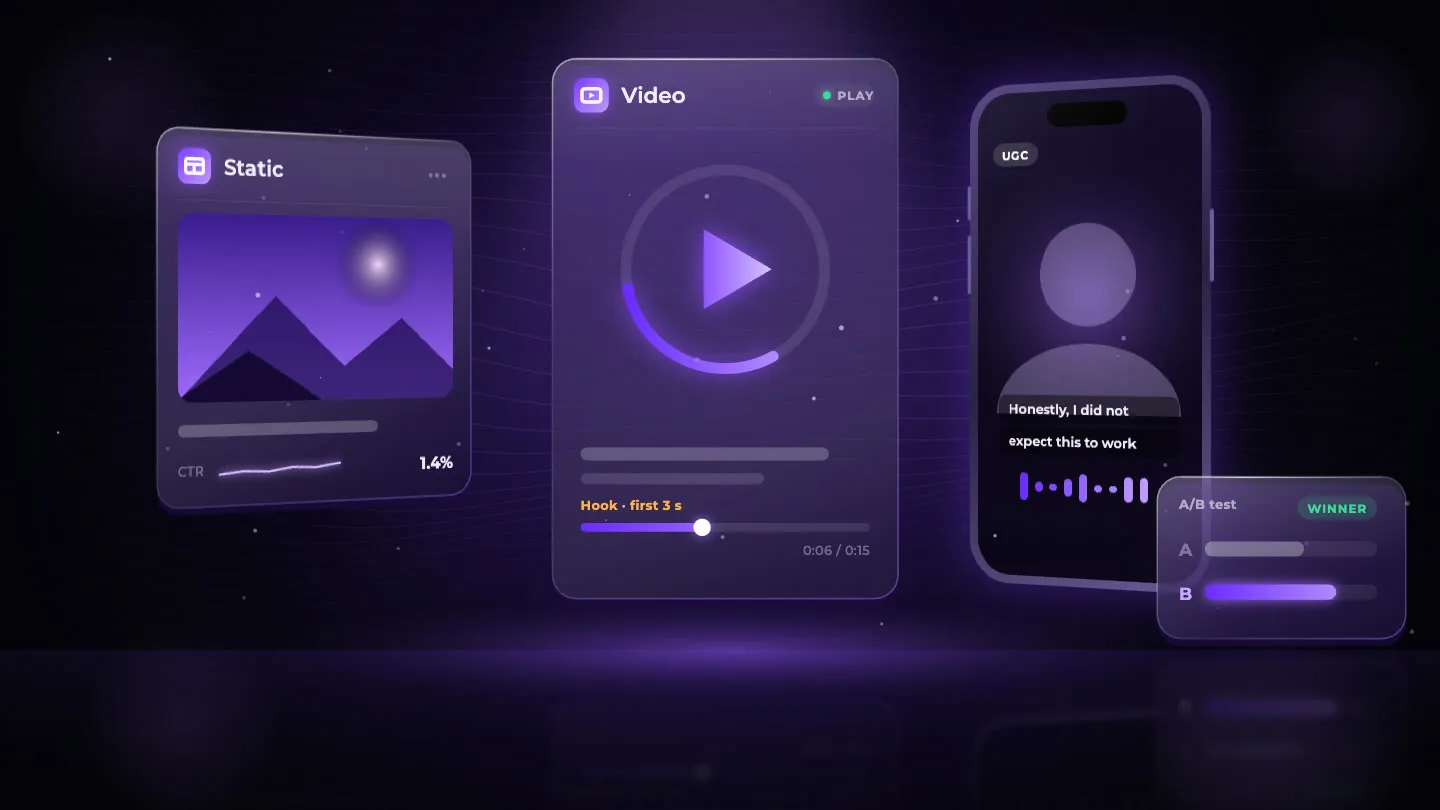
| Format | Strengths | Limitations | Where in the funnel |
|---|---|---|---|
| Static image | fast to produce, cheap to test, good in carousels | lower engagement in Reels and Stories | retargeting, lower funnel, strong offer |
| Video (branded) | reveals the product, holds attention longer, shows quality | more expensive to produce | middle and upper funnel |
| UGC / native video | native look, higher trust, faster and cheaper to produce | needs a charismatic speaker or a real customer | upper funnel, cold audience |
Static wins when the copy and the price speak for themselves. If your offer is clear at a glance — «Nike trainers −40% today» or «Trial Polish lesson for $1» — an image with short copy performs excellently in retargeting and with a warm audience. Images are also faster and cheaper to test: for the cost of one video you can test five different offers.
Video is needed when the product has to be shown. A yoga mat, a clothing lookbook, a production process, a demo of an online service, a before/after treatment — anything where a living presentation says more than a static image. Video holds attention longer and builds a deeper connection with the audience.
UGC and talking-head video are a genre of their own. They look like an ordinary post in the feed rather than an ad. And it is precisely that «non-advertising» quality that catches people who long ago learned to ignore studio banners.
How video beat static: the Be Yoga case
When Be Yoga came to us — selling yoga mats online through Instagram — the first step was not configuring targeting but analysing competitors. We looked at what the people genuinely selling in this niche were doing, and saw a clear picture: the winners use video creatives, not static.
The reason is logical: a yoga mat is a tactile, physical product. The buyer wants to see how it lies on the floor, the texture of the material, how it looks during practice. A static photo conveys that less effectively.
We went straight to making selling videos: the product in action, with quality and benefits visible. In parallel we launched a traffic campaign aimed at followers, to grow the base and build trust in the account. We split the budget between campaigns and ran the video creative against a broad audience and interest-based audiences.
The result after two weeks:
- Ad budget: $262
- Revenue: $952
- ROAS: 363%
- Number of leads: 69
- Cost per lead: $3.53
- First week: 9 sales — full payback plus profit
But there is an important nuance: video wins only when it matches the platform’s native style. Shoot a long corporate clip in the spirit of a TV commercial and it will underperform plain static. Video has to look like content, not like an ad. More on that below.
UGC: why «shot on a phone» often converts better than a studio clip
UGC (user-generated content) is video or photography that looks like an ordinary post from a real user. A review in a natural voice, an unboxing, a story about «what happened after I tried…», a short video filmed at home or in a café.
Three reasons UGC beats studio advertising with a cold audience:
1. People trust people, not brands. When a real person explains to camera why they liked a product, it is far more persuasive than a perfectly shot clip with background music. This is not theory: the social-proof effect is confirmed by results across hundreds of niches.
2. Meta’s algorithm treats UGC closer to organic. Content that looks native and earns engagement (comments, saves, shares) gets promoted in cheaper auctions. «Banner blindness» kicks in far less often with UGC than with a studio ad.
3. Cheaper to produce means more hypotheses. Good UGC can be shot on a phone in 20–30 minutes. A studio clip with staging, editing and voiceover takes days and thousands of dollars. With systematic testing (which is always necessary), UGC lets you check more variants for the same production budget.
Where UGC will not work: in B2B with a conservative buyer, in the luxury segment, or in niches where brand gravitas is part of the product (notaries, investment services, medicine without storytelling). There, trust is built on authority rather than on the format’s «non-advertising» feel.
Talking-head video: a genre with its own rules
This is a distinct sub-type of UGC — video in which a person simply talks to camera. No editing tricks, no background music, no animated captions every two seconds. Just a speaker, a topic and 30–90 seconds of conversation.
The best example from our practice is the Polish-language online school Kanapka. We have been working with them for 18 months. In that time we have tested a huge range of formats: static, carousels, branded video, quizzes, webinar campaigns.
The best performer on a cold audience was talking-head video, in which a teacher or a student speaks in the first person about their experience of learning Polish. No script, no staging. Simply: «Hi, I moved to Poland and here’s what changed in three months after the course».
Why does this work for Kanapka? Because the school sells a service to people going through an emotionally charged situation — emigration, job hunting, adapting to a new country. When a student on camera says what the viewer is feeling themselves, contact happens at the level of identification rather than advertising. The person thinks «this is about me», not «this is an ad».
The result: a stable cost per lead of around $2 sustained over 18 months in the competitive online-education niche — a strong figure, and it holds precisely because new versions of the talking-head format are tested continuously. More in the Kanapka case.
The first 3 seconds: the hook that decides everything
Regardless of format — video, UGC or static — there is one element everything depends on: the first 3 seconds of a video, or the first glance at an image.
That is how long you have to stop someone scrolling the feed. If nothing has happened within 3 seconds, they have moved on. And neither perfect editing nor a strong closing call to action will save it.
What works as a hook in Meta Ads:
- A provocative statement — «This mistake killed the results of 7 of our clients before we found it»
- A question that catches — «How much have you already spent on advertising with nothing to show?»
- An unexpected shot or fact — something that looks unusual for your niche
- A specific promise — «I’ll show you how to get 69 orders for $262»
- A situation of identification — «If you’ve moved to Poland and don’t speak the language yet…»
The hook determines not only whether a person stops, but also which audience responds. This is «creative as targeting» in action: the right hook filters out the irrelevant and attracts those for whom the product matters.
The structure of a video creative that converts:
- Hook (0–3 sec) — stop the person
- Problem (3–15 sec) — they recognise themselves
- Solution (15–40 sec) — your product or service as the answer
- Proof (40–55 sec) — a result, a number, a testimonial, a case
- CTA (55–60 sec) — a specific action, not a vague «learn more»
In short formats under 30 seconds, steps 3–4 compress or merge. But the hook and the CTA are always mandatory, without exception.
How we test creatives at VELAR
Without systematic testing, advertising is a lottery. We follow a clear process regardless of niche or budget.
Step 1: start with 3–5 variants in a single ad set.
Not one «best» creative, but several hypotheses at once. Different hooks, different formats (static plus video at minimum), different angles. The algorithm will distribute impressions itself and show you what engages.
Step 2: watch three metrics — CTR, Hook Rate and Cost per Result.
- CTR — are people clicking the ad at all
- Hook Rate — how many people watched the first 3 seconds of the video (below 25–30% means the problem is the hook, not the product)
- Cost per Result — what the target action costs: a lead, a purchase, a sign-up
Do not optimise too early. The algorithm needs enough conversions to exit the learning phase. Switching things off prematurely destroys the result.
Step 3: on day 5–7, cut the laggards.
If a creative is delivering twice the Cost per Result with no sign of improvement, switch it off. Budget and impressions move to the winners.
Step 4: scale the winners and test again.
This month’s winner is not the winner forever. Meta saturates audiences, and even the strongest creative «tires» after 4–6 weeks of active delivery. Continuous fresh testing is not an expense, it is insurance against a slump.
Step 5: iterate on the winner.
If a video with the hook «How we earned $952 from $262» worked, test variants: a different speaker with the same hook, the same speaker with a different hook, a static version with the same message. One strong creative generates 3–5 further hypotheses to test.
VELAR’s position: creative is your main lever
An advertising budget is fuel. But fuel in a bad engine simply burns. Your engine is the creative.
A larger budget without a better creative produces more wasted money, not more sales. The right video or native UGC on the same budget produces several times the result. This is not theory — we see it on every new project: the first 2–3 weeks are format testing, and that, rather than audiences, is where the difference between profit and loss lives.
Our average ROAS across clients is 598%. That is not the result of some secret targeting. It is the result of treating creative testing as a systematic process rather than a one-off «filmed it, launched it, now we wait».
If your advertising «isn’t working» right now, the first thing to check is whether your ad stops a person within 3 seconds. If it does not, no budget will help.
Want us to go through your current creatives and identify where the leak is? We do exactly that in a free audit — come with your current ad materials and we will show you specifically what to change.
Read also:
- «Meta Ads or Google Ads: which to choose for your business»
- «7 mistakes in a DIY ad launch that drain your budget»
Frequently asked questions
Which is better — video or static in Meta Ads?
It depends on the niche and the stage of the funnel. Video works better on a cold audience and for products that need demonstrating. Static often wins in retargeting and for ads with a strong offer. The optimal approach is to test both formats simultaneously and look at the numbers.
What is UGC content in advertising?
UGC (user-generated content) means creatives shot «like an ordinary person» would: phone video, reviews, native recommendations. Meta's algorithm treats such content as closer to organic, and audiences receive it with more trust than a studio production.
How many creatives do I need to start?
At least 3–5 different variants, ideally mixing formats: static plus video. The algorithm will find the winner itself, but it needs options to compare. Without testing you are simply betting on luck.
Why is the audience good but the results bad?
In most cases the cause is a weak creative, not the audience. Meta's algorithm today finds the right people better than manual targeting did a few years ago. But even the best audience will not buy if the ad does not stop them. Creative comes first.