Lead generation: what it is and how to attract leads online
«Lead generation» is one of those phrases business owners hear at every meeting with marketers but rarely ask to have explained in plain language. And when they do ask, the answer is usually more confusing than the question.
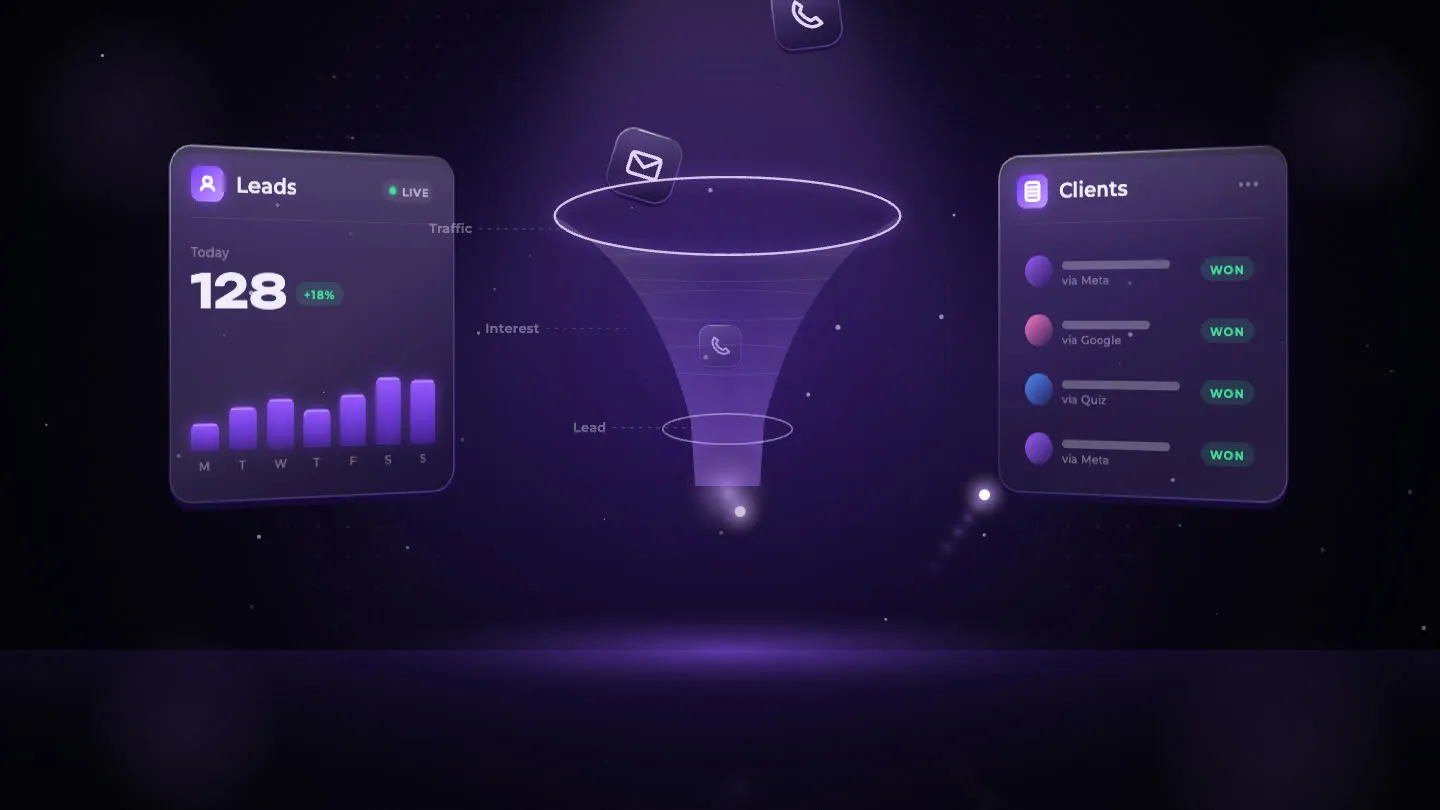
Let’s keep it short: lead generation is the process of attracting contacts from people or companies who have shown interest in your product or service and given permission to be contacted. Not a sale, but the first step towards one. Someone who left a phone number in a form on your site, completed a quiz or booked a free consultation is a lead. They have not bought anything yet, but they are no longer a «cold stranger» from the internet.
In this article we break down what a lead is and how it differs from an enquiry and a customer, which lead generation channels genuinely work in 2026, how B2B lead generation works separately (it is a different game with different rules), and we show on two VELAR cases what this looks like in practice: in education and in a product business.
Lead, enquiry, customer: where exactly the lines fall
Confusion over terminology is the main reason business owners end up arguing with marketers over incomprehensible reports. Let’s sort it out.
- Lead — the contact of a person or company who has shown interest in your product. That could be a phone number, an email address, a direct message on Instagram, a completed quiz. The minimum threshold of interest.
- Enquiry — essentially also a lead, but with a more specific intent: booking a consultation, a «calculate the cost» form, a call to the sales team. An enquiry is closer to a purchase than a plain «lead».
- Qualified lead (MQL/SQL) — a lead checked against your criteria: ability to pay, need, geography, business size. An MQL (Marketing Qualified Lead) is interesting from a marketing standpoint; an SQL (Sales Qualified Lead) is ready for a conversation with sales.
- Customer — a lead who reached payment.
Why the owner, not just the marketer, needs to understand this: if you only count the number of leads and celebrate «we had 200 enquiries this month» without looking at how many became sales, you are celebrating the wrong figure. A volume of leads with no conversion into sales is spent budget disguised as a result. The right metric is not CPL (cost per lead) on its own, but how CPL relates to customer acquisition cost (CAC) and the margin on a single deal.
How lead generation works: the main channels
Lead generation is not a single «launch advertising» button. It is a combination of channels, each bringing in people at different stages of readiness to buy.
Paid advertising (Meta Ads, Google Ads). The fastest way to get the first leads — you pay for impressions and clicks and receive contacts within days rather than months. Meta works well where the decision is emotional and impulsive: physical products, services, educational products. Google (especially Search and Performance Max) is strong where demand already exists — the person is actively searching for «buy X» or «order Y».
Landing pages and quiz funnels. A form on a site collects cold leads, while a quiz funnel is a flexible tool that simultaneously qualifies the lead (the person describes their own need as they move through the steps) and raises conversion through engagement in the process. A quiz funnel is exactly what we built for Kanapka — more on that below.
SEO and content. A slower but long-term channel: an article or pillar page brings traffic from organic search for months and years with no direct cost per click. It works well alongside paid advertising — while advertising delivers quick results, content builds an asset that keeps producing leads even if the ad budget is paused for a while.
Email and retargeting. Not a source of new leads, but a tool for closing those who already left their contact details but did not buy. In long deal cycles (especially in B2B) this stage often decides whether a lead reaches payment or goes cold.
Social media and SMM. Direct messages on Instagram and Facebook, comments under posts, organic content — a less scalable channel, but one with high trust: the person arrives already somewhat familiar with you through your content rather than «from an ad by an unknown brand».
There is no «best» channel in the general sense — there is the channel that suits a specific niche and deal cycle. In the next section, why this matters especially in B2B.
B2B lead generation: a different game with different rules
This deserves its own section, because B2C lead generation logic applied literally to B2B almost always ends in disappointment.
The decision is not made by one person. In B2C someone sees an ad and buys for themselves. In B2B the lead who submitted the enquiry is often not the person who signs off the budget: they are looking for a solution, while the final «yes» comes from a manager or a procurement department. That means even a perfect lead does not guarantee a deal without further work from sales.
The deal cycle is far longer. Instead of «saw the ad, bought within the hour», a typical B2B funnel runs for weeks or months: first contact, presentation, trial period, agreeing terms, signing the contract. Advertising optimised for an immediate purchase simply does not have time to «learn» in B2B, because there are too few conversions for the algorithm (more on this mechanism in the article on Performance Max).
Qualification matters more than volume. In B2C, 200 cheap leads can be a normal result even if some of them are junk — conversion into sales still covers the budget through sheer volume. In B2B, 20 quality leads matching your ICP (ideal customer profile: company size, industry, budget) are often worth more than 200 random contacts the sales team spends months calling with nothing to show.
What actually works in B2B lead generation:
- Precise qualification at the entry point — a form or quiz that immediately filters out irrelevant enquiries (business size, budget, industry), rather than simply collecting «anyone who left a number».
- Content and SEO as a long trust channel — a B2B buyer rarely buys on first contact, and the article or case study they read before the call often matters more than the advertising itself.
- LinkedIn and email for nurturing — where B2C channels such as Instagram Stories work poorly on business decision-makers.
- A tight link between marketing and sales — a lead without fast, competent follow-up from sales loses interest within days, however much money went into acquiring them.
VELAR’s position: judging a B2B campaign by cost per lead is a mistake. An impressive CPL of ₴300 means nothing if none of those leads reached a deal. We always bring the client round to a conversation about how many leads actually become customers and what the resulting customer acquisition cost (CAC) is — that is the real measure of B2B lead generation effectiveness.
Kanapka case: a quiz funnel holding ~$2 per lead for 18 months straight
Kanapka is a Polish-language online school with a ten-year history: over 15,000 graduates and 58,000+ YouTube subscribers. The brand was already advertising on Meta before us, but the previous contractor tested nothing and sought no new combinations — the entire flow of customers rested on one or two campaigns.
The task was not «launch advertising» but to build a system: several traffic sources and many working combinations instead of dependence on a single campaign.
What we did:
- Added Google Ads as a second traffic source — previously the client worked only on Meta.
- On Meta we continuously test new audiences, creatives and formats, including webinars and collaborations.
- We develop the client’s Instagram profile and run separate advertising campaigns for it.
- We built a quiz funnel: the person goes through several steps about their level and their goal in learning the language, then books a trial lesson — this produced a stable working combination with a large flow of enquiries.
The result: average cost per lead holds steadily at around $2 — a strong figure for the education niche. Effective advertising gave the business the cash flow to grow: the client has updated the site and is planning a TikTok test. The collaboration has now run for 18 months — the duration itself being indirect confirmation that the result is stable.
The main lead generation lesson from this case: a quiz funnel both generates leads and qualifies them at the same time. Someone who has worked through five steps of a quiz is considerably «warmer» than someone who simply pressed «Call me back» — and that directly affects how many leads actually make it to booking a lesson.
TOP TREND case: 5,000+ leads in physical products within a strict KPI
The second case involves different mechanics and a different niche. TOP TREND is a product business: homeware and garden goods, car accessories, small electronics. The task was to reach a target cost per conversion within a KPI of ₴150–450 and scale lead volume through Google Ads.
The starting conditions were not easy: the client had previously worked with several agencies, moved between accounts because of spending limits and a change of legal status, and one account had even been temporarily blocked. Most significantly — there was no access to Google Merchant Center or Google Analytics, because the client is an intermediary.
What we did:
- Performance Max + DemandGen as the main sales channels; search was used sparingly because of the high cost per click in these categories.
- A separate landing page and separate campaign for each product — this made it possible to compare performance accurately between products rather than relying on an averaged figure.
- Three ad groups: broad audience, interest and demographic signals, and custom segments (similar sites, search queries, behaviour).
- Custom audiences built on site visitors and dynamic remarketing through DemandGen.
The result: 5,000+ leads, a realised budget of ₴1m+, average cost per lead of ₴297.86 — within the target KPI, even without access to Merchant Center or Analytics.
| Kanapka (education) | TOP TREND (physical products) | |
|---|---|---|
| Main channels | Meta + Google Ads | Google Ads (Performance Max + DemandGen) |
| Lead generation mechanic | quiz funnel | a separate landing page per product |
| Key metric | ~$2 per lead | ₴297.86 per lead (KPI ₴150–450) |
| Stability indicator | 18 months of continuous work | 5,000+ leads, ₴1m+ budget delivered within KPI |
These are different niches, different currencies and figures that cannot be compared directly — but the shared principle is the same: in both cases lead generation became predictable not because «we launched advertising», but because the mechanic (a quiz, or a landing-page structure organised by product) was matched to the buyer’s specific decision-making model.
Typical mistakes in lead generation
Chasing lead volume instead of quality. A cheap CPL where no lead ever buys is worse than a more expensive CPL with high conversion into sales. Count CAC (customer acquisition cost), not just CPL.
No qualification at the entry point. A form with a single «leave your number» field brings the maximum number of contacts and the minimum number of people ready to buy. A quiz, clarifying questions and a clear description of the offer all filter out irrelevant people before sales even picks up the phone.
Slow or non-existent follow-up. A lead who is not contacted within the first few hours goes cold — especially in B2C with its short decision cycle. The best advertising loses to a slow sales team.
One channel instead of a system. Dependence on a single campaign or a single traffic source is a fragile model: the algorithm changes, the auction gets more expensive, the account gets banned — and the flow of leads stops instantly. This is exactly what we found at Kanapka before we started: the whole business rested on one or two campaigns.
Judging only by cost per lead, without accounting for funnel length. This is especially dangerous in B2B — comparing a ₴300 CPL with a ₴100 CPL without accounting for how many of those leads reached a deal means comparing the wrong numbers.
VELAR’s position: a lead is not the result, it is the beginning
Lead generation is often sold as the final goal: «we’ll get you leads». But a lead is not a sale and not money in the till. It is a person who has taken the first step and is waiting to see what you do about the second.
Our position: a lead generation system works only when it is built as a sequence — from channel to qualification, from qualification to sales, and back to analysing which leads actually became customers. That is why in both cases above the result came not from «we launched advertising and got leads», but from systematic work: several channels at Kanapka, a precise campaign structure by product at TOP TREND, and in both cases continuous testing rather than a single campaign on autopilot.
If you are getting leads but do not understand why some of them never reach a sale, or you want to build a lead generation system with several traffic sources instead of depending on one campaign, that is exactly what we examine in a free audit. We look at the channels, the funnel and where exactly leads are being lost between enquiry and payment.
Read also:
- «7 mistakes in a DIY ad launch that drain your budget»
- «Targeting yourself or handing it to an agency: an honest breakdown in numbers»
- «What ROAS is and what counts as a good figure»
Frequently asked questions
What is lead generation in simple terms?
Lead generation is the process of attracting contact details from people or companies who have shown interest in your product or service: they left an enquiry, a phone number, an email address, or booked a consultation. A lead is not yet a customer — it is a person who has taken the first step towards you and given permission to be contacted. The job of lead generation is not to sell immediately, but to obtain the contact and bring them into the sales funnel.
How does a lead differ from an enquiry and a customer?
A lead is the contact of someone who has shown interest (left a number, an email, completed a quiz). An enquiry is a specific action with intent (booking a consultation, a call, a «calculate the cost» form) — essentially also a lead, but with a clearer intent to buy. A customer is a lead who reached payment. Confusion arises when a business counts «leads» instead of «sales» and celebrates figures that never convert into money.